Middletown Volunteers

Cannon

The list details members of the Middletown Volunteers, including recruits and substitutes, with their service dates and outcomes using standard abbreviations. It includes information on discharges, promotions, injuries, and deaths among the volunteers.

Transportation in Middlesex County

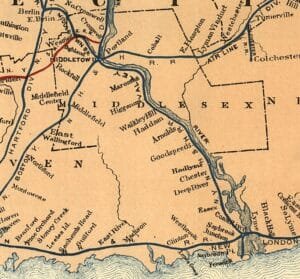
1893 Map of Connecticut Railraods by Tilden - Middlesex County

Middlesex County’s transportation history primarily revolved around ferries crossing the Connecticut River until the advent of railroads. Early ferries were chartered as far back as 1662, but their significance waned with the establishment of railroads like the Air Line and Shore Line Railroads, reducing ferry usage. The county’s transportation evolved with the construction of roads and turnpikes in the 19th century, aimed at connecting settlements more efficiently. By the late 1800s, various railroads, including the Meriden and Cromwell Railroad, were developed to improve access for manufacturers and facilitate commerce.

The Bench and Bar of Middlesex County

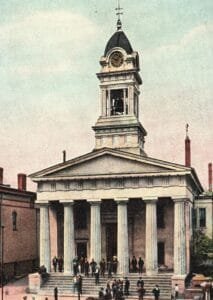
Old Court House, Middletown, Connecticut

Middlesex County, established in 1785, emerged as a significant hub for commerce and legal affairs in Connecticut, particularly due to the prominence of Middletown as a leading port. The county became a vital area for litigation, influencing early commercial law. Notable lawyers such as Titus Hosmer and his son Stephen shaped the legal landscape, with a legacy of influential attorneys practicing there. The Superior Court sessions were known for their eloquent legal arguments, contributing to the county’s rich legal history. Over the years, many distinguished figures emerged, bolstering Middlesex’s reputation in the state’s legal community.

Dr. Richard Warner of Cromwell

1859 Map of Middlesex County Connecitcut - small

Richard Warner, a Yale graduate of 1821, practiced medicine in Hadlyme and Middletown Upper Houses, becoming a prominent physician and president of the Connecticut Medical Society. He was known for his strong observational skills, interest in botany and mineralogy, and involvement in social causes like anti-slavery and temperance. A leading community member, he advocated for innovations that were initially ridiculed. Warner played a key role in establishing the town of Cromwell and was active in local improvements and church activities until his death in 1853 at fifty-nine.

The Woodward Doctors of Middletown

1859 Map of Middlesex County Connecitcut - small

Dr. Henry Woodward, born in 1795 in Torringford, Connecticut, became a respected physician in Middletown after studying under his father and brother. He had a thriving practice and was known for his moral character and charitable work. He served in the State Legislature before dying from a chest disease in 1832 at 37. His brother, Dr. Charles Woodward, also a physician, continued his legacy in Middletown, gaining respect for his benevolence and commitment to the medical profession. He served in the State Senate and was instrumental in establishing the loca hospital before his death in 1870.

Dr. William Tully of Middletown

1859 Map of Middlesex County Connecitcut - small

William Tully, born in 1785 in Connecticut, was a prominent physician and educator. Graduating from Yale, he studied medicine under Nathan Smith at Dartmouth, developing a strong interest in botany. Tully practiced medicine in various locations, eventually settling in Middletown. He co-authored a controversial medical book on fevers and served as a professor at the Vermont Academy of Medicine and Yale College. Known for his thorough scholarship, he published notable works, including a comprehensive treatise on Materia Medica. Tully passed away in 1859, leaving a significant legacy in the medical field.

Dr. Thomas Miner of Middletown

1859 Map of Middlesex County Connecitcut - small

Dr. Thomas Miner, born in Westfield, Connecticut, in 1777, graduated from Yale College in 1796. Initially studying law and teaching, he shifted to medicine at 25 under Dr. Osborn in Middletown. He began practicing in 1807 but faced health issues, notably heart disease, which curtailed his career in 1819. Despite this, he contributed significantly to medical literature, co-authoring influential works and earning an honorary M.D. from Yale. A respected linguist and leader in the medical community, he served as president of the Medical Society of Connecticut before his death in 1841 at age 64.

Dr. William Brenton Hall of Middletown

1859 Map of Middlesex County Connecitcut - small

Dr. William Brenton Hall, born in 1764, was a prominent physician and surgeon in Middletown, Connecticut, known for his dedicated service during the yellow fever outbreak in 1796. He graduated from Yale College in 1786 and specialized in surgery, becoming an esteemed member of the medical society. Dr. Hall was also a pioneer in smallpox inoculation and was recognized for his hospitality, supporting the medical community. He passed away in 1809 at the age of 45 after an accident. His contributions to medicine and community care were significant during his lifetime.

Dr. John Osborn of Middletown

1859 Map of Middlesex County Connecitcut - small

Dr. John Osborn, a key figure in the early Connecticut Medical Society, organized the county’s medical society and served as its first chairman and treasurer. Educated at Harvard, he initially contemplated a career in ministry but shifted to medicine. He excelled in his field, notably advocating for smallpox inoculation and training numerous physicians. Known for his integrity and straightforwardness, Osborn was a prominent and sometimes intimidating figure in Middletown, where he practiced for over sixty years before passing away in 1825. His legacy continued through his sons, who also pursued medicine.

The Original Condition of Middlesex County

1859 Map of Middlesex County Connecitcut - small

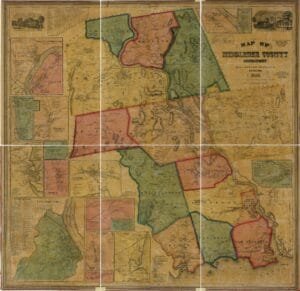
Middlesex County was established in 1785, originally comprising six towns from Hartford and New London counties, later expanding to fifteen towns, with Durham joining in 1799. The county features a varied landscape, including hills and the Connecticut River, which provides water power for mills. Historically rich in timber and fish, wildlife has significantly diminished due to human activity. The original forests, primarily oak and walnut, have mostly vanished, with only a small growth remaining. Various animals have also disappeared, leading to a dramatic change in the region’s ecology over time.